
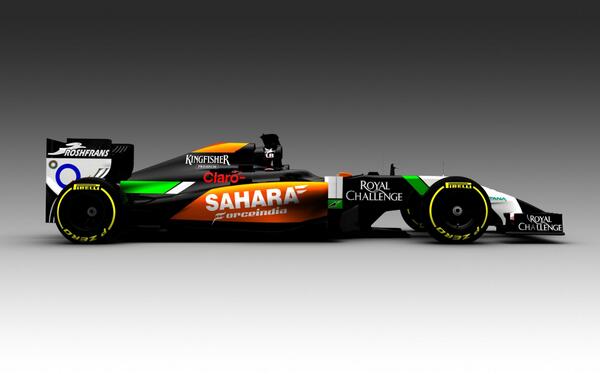
Force India has shown a picture of its new car
Force India has unveiled a picture of its new VJM07, featuring a dramatic new livery. However the side view doesn’t give much indication of what the new nose looks like.
Technical Director Andrew Green said: “Almost every single part is a new design, from the front wing right back to the diffuser. The genetics of the VJM07 still lie in the 2013 car, but we’ve had to achieve the same results in a slightly different way.
“It’s been a massive job to accommodate all the changes to the power unit – it’s the biggest change I’ve witnessed in the sport since I started in 1990. Cooling has been the biggest challenge with most of last summer taken up trying to understand the cooling requirements of the power unit, and how best to optimise it in the chassis.”
Green says that outwardly the car looks similar to its predecessor, apart of course from the nose.
“From where we stand it doesn’t look hugely different, but it is, every single part of it is different, from the front wing right back to the diffuser. Its genetics still lie in the 2013 car, and it’s based around the same concepts, But we’ve had to achieve the same results in a slightly different way. The nose is a stand out, but from the nose backwards, it looks quite similar. It’s a little bit ‘fatter’ for the cooling requirements, but we hope to trim that fat out during the early part of the season. If you want to be competitive you have to develop, because there are so many areas that need refining if you’re going to optimise the car. It’s a big challenge.
“The aerodynamic changes in themselves would have been significant, even if there had been no other changes. There’s quite a dramatic reduction in downforce, especially with regard to the exhaust – there’s very little you can do to capture the exhaust energy. That’s a big loss on the exit of corners, so traction becomes a premium. That combined with a change in the front wing width changed all the flow structures on the car completely. That was a big task, rebuilding all those structures from the front, and then there’s a smaller rear wing as well.
“The loss of the lower wing, or beam wing, leads to a signifcant loss of performance. That lower wing helped connect the diffuser to the top wing, and gave those two areas a lot of support. Without it it became very difficult to extract performance, and it’s going to be quite a tricky area to keep stable. So there’s quite a dramatic loss in headline downforce numbers, while there’s also a drop in drag, which has fallen quite dramatically as well.”

 Adam Cooper F1