
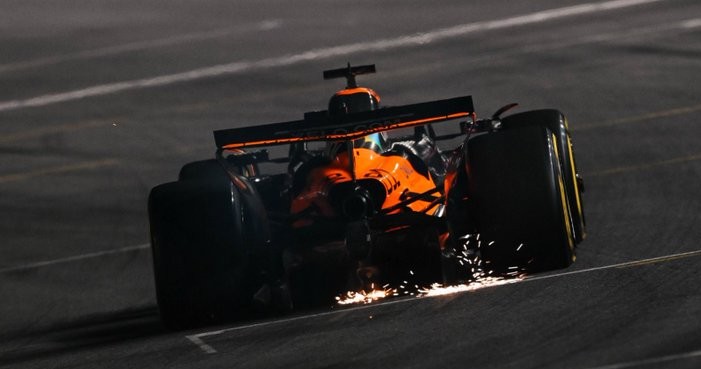
McLaren Formula 1 team boss Andrea Stella has provided more detail on what led to the Las Vegas GP disqualifications of both Lando Norris and Oscar Piastri.
The Italian reiterated that the unexpected arrival of porpoising in Saturday’s race meant that that the cars were bottoming more than had been anticipated, an argument it used in discussion with the FIA.
He admitted that having realised that porpoising might become an issue for plank wear the team tried unsuccessfully to mitigate it, but failed to prevent the wear from going beyond the prescribed 9mm.
“The specific cause that led to the situation was the unexpected occurrence of extensive porpoising, inducing large vertical oscillations of the car,” Stella said in a Q&A issued by the team on Thursday.
“The level of porpoising was exacerbated by the conditions in which the car operated during the race, and it was not anticipated based on what we had seen in practice and based on the predictions of the car operating window in the race.
“Based on the data we had acquired in practice, we do not believe we took excessive risks in terms of ride height and we also added a safety margin for qualifying and the race, compared to practice, in terms of clearance to the ground.
“However, the safety margin was negated by the unexpected onset of the large vertical oscillations, which caused the car to touch the ground.
“The porpoising condition that the car developed in the race was also a difficult one to mitigate, as even a reduction in speed – an action that, in theory, should increase clearance to the ground – was only effective in some parts of the track but in others was actually counterproductive.”
Stella stressed that the team was keeping a close eye on the situation with the help of sensors that measure load, the standard way that teams monitor potential planl wear issues.
“From the early laps of the race, it was clear from the data that the level of unexpected porpoising would be a concern,” he said.
“We were able to monitor the situation better on Lando’s car using telemetry data, but it was made more difficult on Oscar’s car, after we lost one of the sensors we use to establish the level of grounding.
“We realised relatively soon that this level of porpoising was causing a high level of skid wear energy, and this is the reason why both drivers started to take remedial actions in various parts of the circuit.
“Unfortunately, we also saw that, because of the car operating window and the circuit characteristics, most of these actions were not effective enough in reducing porpoising.”
Stella said that the team understood that there was no alternative but to disqualify the cars.
“We verified together with the technical delegate, that the measurement of the skid thickness was correct. Even if the excessive wear is relatively minor and in only one location, (as it was 0.12 mm for Lando and 0.26mm for Oscar), the regulation is very clear that the rear skids need to be at least 9mm at the end of the race in every location.
“Unlike sporting or financial rules – there is no proportionality in the application of penalties for technical regulation infringements.”
However he suggested that could change in the future: “The FIA itself has admitted that this lack of proportionality should be addressed in the future to ensure that minor and accidental technical infringements, with minimal or no performance benefits, do not lead to disproportionate consequences.
“It should also be remembered that the FIA itself emphasised that the infringement was not intentional, there was no deliberate attempt to circumvent the regulations, and there were also mitigating circumstances, as we explained to the event stewards.”
Stella says that Las Vegas was in effect a one-off, and he doesn’t expect to see a recurrence in the last two races.
“The conditions we experienced last weekend and which led to the onset of porpoising and excess of grounding, compared to what was expected, are very specific to the operating window of the car in Vegas and the circuit characteristics.
“We have a well-established and consolidated way of setting up the car and we are confident that this will lead us to an optimal plan for the coming races, starting from the Lusail International Circuit.
“Nevertheless, we learn from every lesson and the one in Las Vegas has been able to provide some useful information about the operating window of the car and the porpoising regime.”
In a similar vein he was keen to point out that the issue did not occur because the team was pushing the limits of performance with low ride heights, and got caught out.
“What happened in Vegas was due to an anomaly in the behaviour of the car, rather than it being the outcome of an excessive or unreasonable chase of performance,” he said.
“Our way of acting and thinking as a team, with a strong focus on performance, has brought us to where we are today, namely winning two consecutive Constructors’ titles and having two drivers at the top of the championship with two races to go.
“We, as a team, constantly learn from experience and we calibrate our approach all the time and we will certainly use any information gained through the situation experienced in Vegas.”

 Adam Cooper F1