
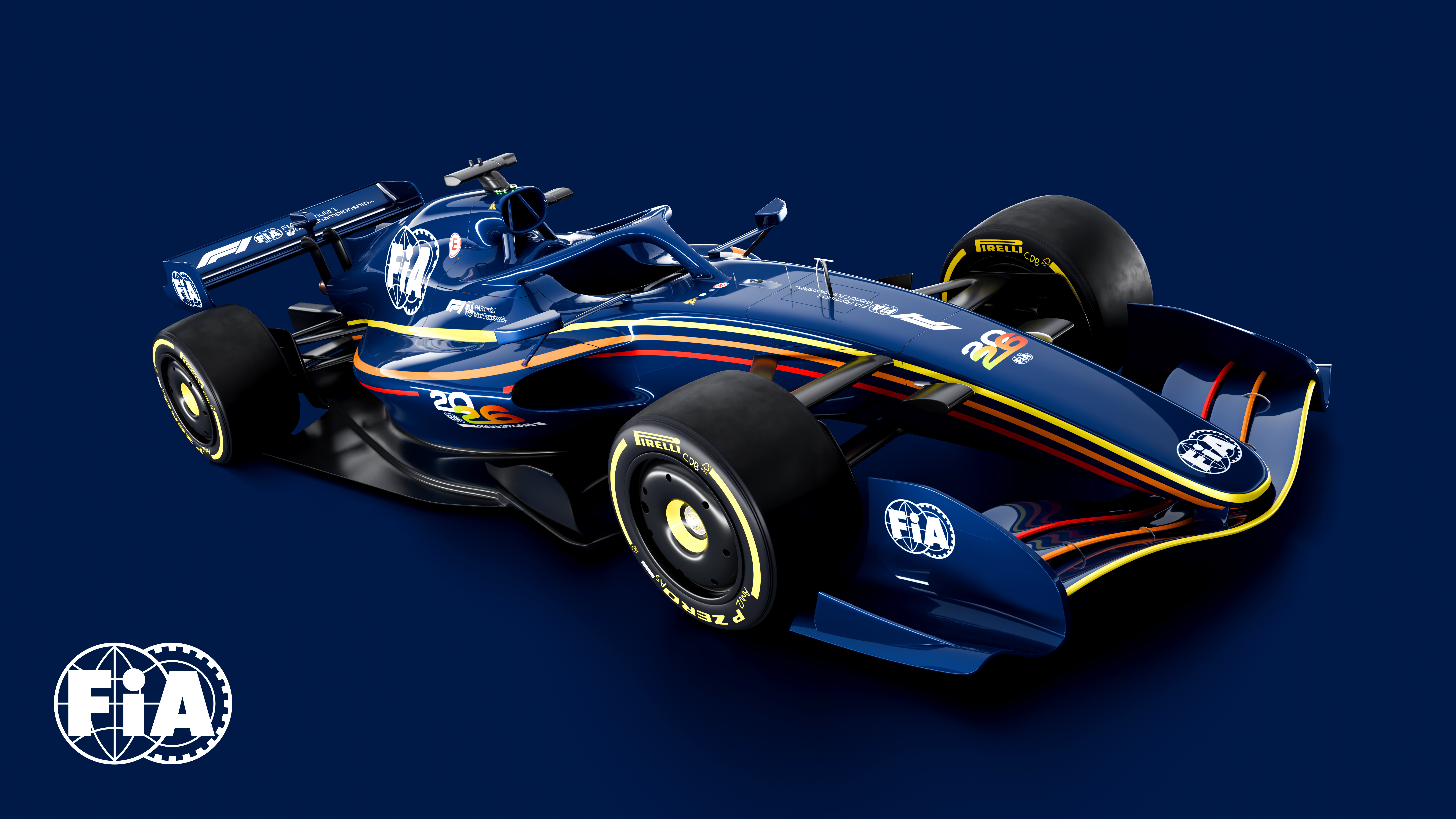
The 2026 cars will be lighter and smaller than the current ones, albeit not by much…
The FIA has released the first details of the 2026 Formula 1 technical rules package, which is set to be ratified by the World Motor Sport Council at the end of this month.
While the power unit spec has been available for some time the chassis regulations have been under debate.
Significantly the new cars will be 30kgs lighter – with the limit cut from 798kgs to 768kgs – and they will be 100mm narrower, and shorter, with the wheelbase trimmed by 200mm. The floor will be 150mm narrower.
As Pirelli requested 18-inch tyres have been retained, although they will be reduced in width by 25mm at the front, and 30mm at the rear.
The cars will also have active aerodynamics, with moveable front and rear wings. The FIA says that the system “will result in greater cornering speeds with standard Z-Mode deployed. On straights drivers will be able to switch to X-Mode a low-drag configuration designed to maximise straight-line speed.”
Expanding on the aero package the FIA notes the following changes: “A three-element active rear wing will be adopted, while the lower beam wing has been removed and end plates have been simplified.
“The front wing will be 100mm narrower than currently and will feature a two-element active flap.
“In contrast to the current cars, front wheel arches will be removed, and part of the wheel bodywork will be mandated, to help achieve optimal wake performance.
“In-washing wheel wake control boards will sit on the front of the side pods to assist with the control of the wheel wake.
“The cars will feature a partially flat floor and a lower-powered diffuser, which will reduce the ground effect and the reliance of the cars on ultra-stiff and low set-ups.
FIA president Mohammed ben Sulayem is bullish about the prospects for the new cars, which will use sustainable fuel.
“Following the publication of 2026 power unit regulations two years ago we have taken the opportunity to redefine the chassis regulations to match the energy requirement of the new power units,” he said.
“Collaborating with our partners at Formula 1 and with the assistance of the sport’s 10 teams and all our stakeholders this represents a unique revision that will ensure our premier championship is even more relevant to what is happening in the world.
“The power unit regulations have already resulted in a record number of PU manufacturers committing to the sport. And now, in tandem with chassis regulations that provide for lighter, more agile cars featuring innovative aerodynamic solutions, we have created a set of regulations designed to not only improve racing but also to make the championship even more attractive to PU manufacturers, OEMs and existing competitors.
“The key features of the 2026 F1 regulations are advanced, sustainability technology and safety. Our aim, together with Formula 1, was to produce a car that was right for the future of the sport’s elite category. We believe we have achieved that goal.”
F1 CEO Stefano Domenicali added: “These regulations mark a significant moment in the future of our sport as we look forward to a new generation of car and power unit that aims to give our fans closer and exciting racing.
“The new sustainably fuelled hybrid power unit presents a huge opportunity for the global automotive industry, the drop in fuel has the potential to be used by cars around the world and dramatically cut emissions. Its potential is one of the key reasons why we will have a record number of engine suppliers in Formula 1 in 2026.
“We enter this new regulatory cycle with the sport in the strongest position it has ever been, and I am confident that the work done by the FIA to create these regulations will further strengthen the position of the sport around the world.”




 Adam Cooper F1