
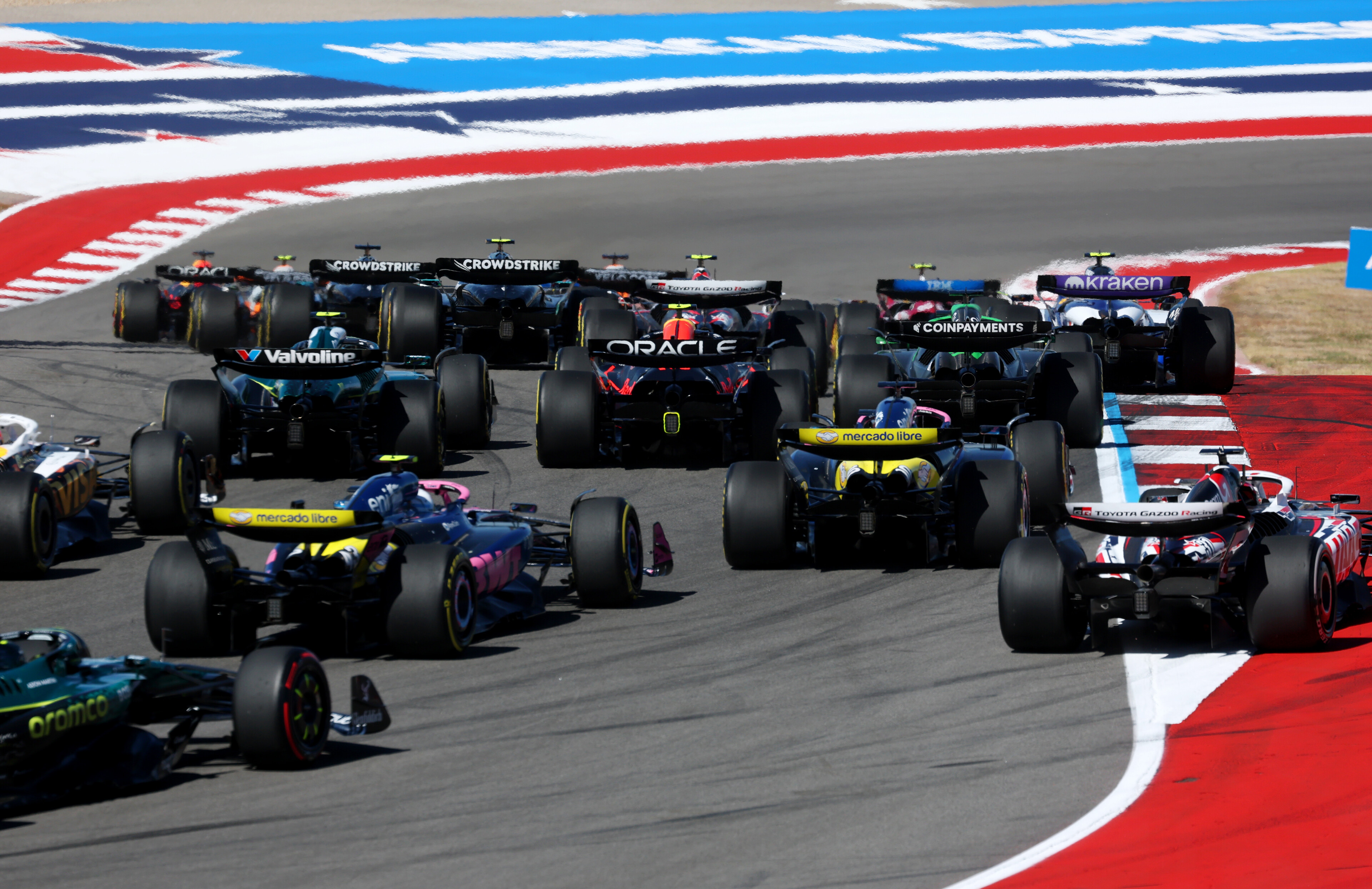
The US GP brought an intriguing twist on the tyre front as the C1 hard proved to be ineffective in the race, and was quickly abandoned by the three drivers who started on it.
Austin saw Pirelli introduce a double step between compounds, with the C1, C3 and C4 in play, in an attempt to mix up strategies.
Typically the hard is the starting choice of drivers down the field, especially those who are a little out of position after bad qualifying sessions. The general idea is to use its durability to run as far as possible into the race, and hope that a safety car or even a red flag creates a strategic advantage.
That didn’t happen on Sunday, as the tyre simply didn’t switch on properly. Alex Albon abandoned his hards after just seven laps, with Esteban Ocon following on lap 24, and Isack Hadjar on lap 28.
When you consider that Lance Stroll was also able to run as far as lap 28 with his softs – three steps away on the compound scale – it’s a good indication that the hard wasn’t working.
In effect Albon, Ocon and Hadjar served as a litmus test for the rest of the field. Their form plus the unexpectedly strong opening stint from Ferrari’s Charles Leclerc on the C4 convinced rivals to go to the softs from the mediums on which they had started.
Prior to the race that decision had not been clear cut, with medium/hard cited by Pirelli as the most likely option for the race.
“We were not even sure that a medium/soft could have been a feasible one-stop,” said McLaren boss Andrea Stella. “So we just discovered through the race what the strategy should have been.
“We saw very early that the hard tyre wasn’t a good tyre, because people were coming off the hard tyre, and before it looked like the medium/soft was a possibility. So in this sense, I think Ferrari had done a good job of anticipating that starting on the soft was a good idea.”
For Albon it was particularly galling as he abandoned the hards so early that he was obliged to switch to a two-stop strategy.
“A hot track, hard tyre, normally that’s a recipe for a good race,” he said when I asked him about it. “The hards worked well last year, and long runs in FP1 looked good as well. So we were kind of licking our lips a little bit when I was told there were not many cars on the hard tyre in front of us. And then at the start of the formation lap, I thought that’s a lot less grip than I expected it to be!”
A first lap clash with Gabreil Bortoleto didn’t help: “We had an incident on lap one anyway, that being said, it didn’t really change much to the race. I don’t think it was my fault or that it was Gabriel’s fault either. Then effectively we just decided to get rid of the tyre, and by doing so, almost started a pit stop back basically in our race.”
This season Esteban Ocon has made often used long opening stints to project himself into the points, and the Haas driver was hoping for more of the same in Austin. Alas this time he was left frustrated.
“I think we just gave the info – myself, Alex and Isaac – for the whole field, really, in not using that hard,” he said. “I think it was the tyre that was not working for this track. I had a good start, gained three or four positions. It was pretty good after Turn 1. But unfortunately, I lost it all after three laps. I had no pace, was sliding a lot. It was extremely difficult out there, and when we boxed into the medium, the pace was decent. It was the same as most people that were fighting ahead, but I couldn’t recover after what we lost. So we didn’t get it right this race.”
Given that Hadjar was starting in P20 after his costly Q1 crash Racing Bulls had to try something, but it didn’t pay off as he followed Ocon home in P16.
“The race I anticipated, to be honest,” said the Frenchman. “The race was obviously not amazing today, it was average. And strategy, we wanted to go long and something to happen. But it wasn’t the case. I didn’t want to start on the hard today. I knew soft/medium were just enough to make the whole race, but obviously starting P20, you want to try things that don’t really make sense. So we tried.”
Hadjar stressed that it wasn’t his choice: “If it was down to me, I would have started on another tyre. But I understand that point of view. We had to try something. We had to understand. So I wasn’t against their decision, so that was fine. At least we learned something.”
In Mexico City weekend Pirelli is once again running a two-step compound gap, this time with the C2, C4 and C5 in play. In theory it should be business as usual with the harder tyre a viable race option – it will be interesting to see how it plays out.

 Adam Cooper F1