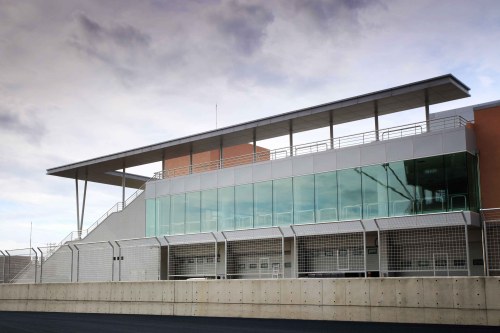
The buildings are up but they forgot to build the track
The FIA is being forced to break its own rules to allow the Korean GP to take place – and is thus setting a precedent that other venues might take advantage of in the future.
In addition the FIA’s rules clearly state that if this year’s race is cancelled at the last minute, it won’t be allowed back on to the 2011 calendar, as a form of penalty.
Although the cars due to head out for first practice on October 22, the track surface has not been completed. Despite that Karun Chandhok is still scheduled to do a demonstration for Red Bull on September 4-5. One FIA source said this week there appeared to be “no way” that run could actually happen.
The FIA’s Appendix O to the International Sporting Code, which governs circuits, clearly states that the final inspection should have taken place 90 days beforehand. If Thursday is deemed the start of the event, that deadline was July 22.
The rules also specify a deadline of 60 days for international events, but even on that more generous measure – one that the governing body is (or was) prepared to use for a Grand Prix in this instance – this inspection should have been completed by August 21.
The relevant regulation reads as follows: “On site inspections will be performed by the Commission’s delegates as necessary, with at least one preliminary inspection and one final inspection. For permanent circuits, the final inspection should be made not later than 60 days (or 90 days for FIA Formula One World Championship events) before the first international event to be held, at which inspection all work relating to the track surface, permanent features and safety installations should be completed to the FIA’s satisfaction.”
It’s accepted that there is bound to be a job list for new circuits after a final inspection, but that usually involves details such positioning of gravel traps and barriers, pit lane arrangements, and so on. An incomplete track surface would seem to be an extreme case…
Clearly there are sound reasons why the FIA specifies these deadlines, since the governing body has a lot of experience, specifically with regard to readiness of the actual track surface. There is obviously now a risk that the surface will be finished in such a hurry that it won’t be fit enough to receive a pounding from 24 F1 cars come October. There is also a danger that, if it is not up to scratch after being completed in a hurry, it could be damaged over its first winter.
Meanwhile one leading team told this blog at Spa that the kitchens of the team hospitality units – which they usually expect to come fully equipped, especially at a new Tilke circuit – have a pipe for cold water, and another for hot. It really is a case of bringing everything, including the kitchen sink…
Bernie Ecclestone continues to insist that all will be well. He’s understandably keen for the race to go ahead, given the commercial implications of a late cancellation, although the accepted wisdom is that in such circumstances the promoters would have to pay their sanctioning fee with or without a race (although that may or may not be affected by who makes the call). It’s hard not to imagine that Bernie is forcing the FIA’s hand here to ensure the race happens.
The rules do not specify what might happen if inspection deadlines are not met, but while vague, they put the decision process into the hands of the World Motor Sport Council, rather than Ecclestone: “It is understood that the organisation of an international event may not be allowed if the required work has not been fully carried out according to the schedule established by the inspector. The FIA (or its World Motor Sport Council) is entitled to allow any international events on a circuit or, if the directions of the Commission have not been complied with, to prohibit them.”
One presumes that Korea could be on the agenda at next week’s WMSC meeting in Italy, after Chandhok’ s scheduled run, so the success or otherwise of that could be key to the discussions.
The World Council might also like to consider the following extract from the FIA’s F1 Sporting Regulations: “An Event which is cancelled with less than three months written notice to the FIA will not be considered for inclusion in the following year’s Championship unless the FIA judges the cancellation to have been due to force majeure.”
In other words there will be no race in 2011 either. It might be hard for Korea to come up with a suitable excuse, so there’s clearly a lot at stake here. Over to you, M Todt…


