Ecclestone still trying to help Lopez find 2010 F1 seat

Jose Maria Lopez and his advisor Felipe McGough have spent a second day with Bernie Ecclestone in London, as the F1 boss tries to sort out a 2010 seat for the Argentine driver.

Lopez was told by Peter Windsor earlier this week in Charlotte that US F1 would not make the first race in Bahrain. Having made commitments to his sponsors the former GP2 driver immediately began looking for an alternative, and travelled to Europe with McGough, his father, and his touring car team boss, former F3 driver Victor Rosso.

Meetings have taken place today and yesterday as Bernie tries to broker a deal that will presumably see Lopez join Bruno Senna at a reorganised Campos Meta team.

A close associate of Lopez told me today: “US F1 hadn’t finished the car and we had promised everyone that we would be in the first race in Bahrain. That’s why Felipe decided to reorganise everything, because we can’t miss Bahrain. The only thing we want is that ‘Pechito’ drives in F1. Everything else is not important for us.”

Chad Hurley’s advisor Parris Mullins is also still in the loop, and it remains to be seen whether the YouTube founder brings some much need financial support to the Campos project. There has been no response from US F1 to yesterday’s revelations that both Lopez and Hurley have left the team.

4 Comments

Filed under Uncategorized

The end of the road for US F1

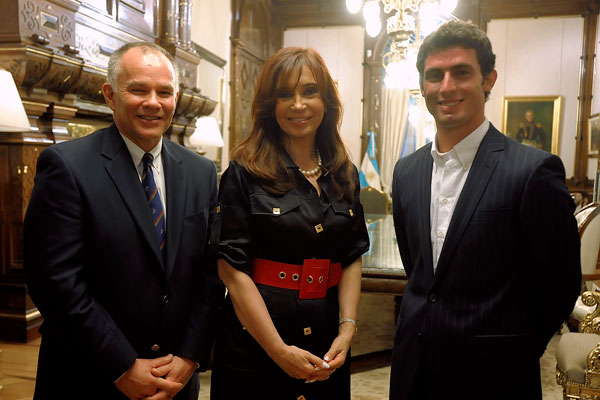
It was all smiles when Peter Windsor and Jose Maria Lopez posed with Argentina's president, Cristina Fernandez de Kirchner, on January 25

The twin sagas of the US F1 and Campos Meta teams have been dragging on for months now, and with FIA technical checks due to take place in Bahrain just three weeks from Thursday, matters have finally reached a head.

A source close to the US F1 team has confirmed what we have all suspected for some time, namely that there is no money, the outfit is nowhere close to being ready for the start of the season, and that it has neither complete cars nor engines.

Peter Windsor gave the bad news to Jose Maria Lopez, his father and his manager/advisor Felipe McGough this week. Lopez is already in Europe trying to salvage a seat with the help of Bernie Ecclestone. As Argentina’s F1 TV producer, McGough is well connected, and knows Ecclestone well.

It’s a complex situation, and Bernie is juggling a lot of balls in the air as he tries to ensure that both Campos and Stefan GP make it to Bahrain in some form or another.

Last week at least three potential saviours were in contact with Dallara about taking over the car designed for Campos. They included none other than US F1 investor Chad Hurley, who apparently realised last week that the game was up, and decided to explore other avenues. He sent close associate Parris Mullins – with former Red Bull man Gunther Steiner acting in an advisory role – to check out the Dallara project. The car is nearly complete and is said to have potential, although obviously work has been on hold of late.

The Campos Meta team, now led by original investor Jose Ramon Carabante, has since confirmed that it still wants the Dallara, and Hurley and other potential customers have been thanked for their interest. It seems that Hurley is still in the frame, and there remains a scenario where both he and Lopez could get involved with the Campos Meta project.

However, sources suggest that although he sees some value in Grand Prix racing Hurley may be so disenchanted after the US F1 debacle that he’s not sure he wants to pursue it. “I think he doesn’t know what to do,” says one insider. Logic suggests that his money might be better spent on a more established outfit, and no doubt several are already chasing him.

Meanwhile Stefan GP is waiting in the wings, and the team could yet find its way onto the grid in Bahrain. Two complete cars are in Cologne, awaiting possible shipment to the Middle East, and Kazuki Nakajima has been busy in the Toyota simulator. A test is planned for Portugal later this month, but there are question marks about whether Bridgestone is willing co-operate with the team, unless it becomes a bona fide entry.

While everyone would agree that having 12 or even 13 teams on the grid would be good for the sport – that is after all why the FIA launched its campaign to bring in more entries – the problem now is that if either one or both of the Campos and Stefan teams is to make it to Bahrain, everything is going to have to happen way too fast, and with either insufficient testing, or none at all. It could all be very embarassing for F1, and the FIA will be keen to see that things are done properly.

There’s one matter that should not be overlooked. With due respect to car builders Dallara and Toyota, the circumstances may also compromise safety – and no doubt both companies are well aware that their reputations could be at stake.

8 Comments

Filed under Uncategorized

The Cooper Files: The day Michael Schumacher cried

I’ve been writing about Michael Schumacher since he contested the Brands Hatch Formula Ford Festival in 1988, and in the run up to his comeback race in Bahrain it seemed a good time to take a look into the past of the biggest name in the sport. 

One of the most unusual events in Michael’s career came at Monza in 2000, where he equalled Ayrton Senna’s tally of 41 wins. In the TV unilaterals after the race he stunned the world when he broke down in tears, causing rival Mika Hakkinen to put a reassuring arm around his shoulders. Nobody had ever seen Michael like this before – and indeed, we’ve never seen such a public display of emotion from him since. 

After a run of bad weekends Monza saw Michael get his title challenge back on track, as he moved with two points of Hakkinen. The race also saw the death of a fire marshal, hit by a wheel torn from Heinz-Harald Frentzen’s Jordan – although Michael himself didn’t know about the tragedy until after the press conference. I wrote this short column a couple of days after the race.

The tracks of Michael’s tears (First published: September 2000)

Michael Schumacher’s tearful reaction in the post-race TV interviews at Monza came as shock to just about everybody. One thing is certain; at that stage he did not yet know that a marshal had been killed. He only learned the news during a much later interview back in the paddock, whereupon he immediately stopped proceedings and went back to the team motorhome.

So what was it all about? One can only guess at what sort of emotions were stirring around in Michael’s head after the race. He never hides his enjoyment on the podium, but this time he did seem a little bit more expressive than usual, staying on after Mika Hakkinen and his brother Ralf had gone to enjoy the moment for a little longer. Obviously he must have been seriously affected by winning at Monza in front of the tifosi for the third time in five years.

In so doing he ended his drought after suffering through so many disappointments during his recent string of bad weekends. That included the first corner crashes in Austria and Hockenheim, and being passed by Hakkinen in Hungary and – most humiliatingly – in his personal kingdom at Spa. Monza was also important because he finally equalled Ayrton Senna’s tally of 41 victories, leaving only Alain Prost ahead of him in the record books.

Schumacher won at Imola on the day that Ayrton was killed, and since then he has rarely talked about the Brazilian. Usually he professes to have no interest in statistics, but clearly the mention of Senna’s name by the interviewer in the already hyped-up circumstances pushed Michael through some kind of barrier.

Something else could have played a part. What few people outside his immediate circle knew was that at Monza he learned that an old friend had suffered a stroke. Willi Bergmeister was the garage owner in Kerpen who first employed him and gave him his mechanic’s apprenticeship, and helped to fund the teenager’s early racing exploits. Although Bergmeister is apparently out of danger, the news obviously affected his former protégé, who started making phone calls as soon as he heard.

There’s nothing wrong with a few tears from a bloke, and we saw Hakkinen having a private blub after spinning at this very race last year, although he thought he was away from prying eyes and was unaware of the helicopter hovering above. More than once, after a hard race or even a particularly tense qualifying session pole, Mika has struggled to find the right words in a press conference. But that was nothing compared with Rubens Barrichello’s amazing and affecting outburst of pure emotion on the podium in Hockenheim.

We often see Olympic champions cry on the rostrum when the national anthem is played, but this was something extraordinary. Rubens made no secret of the fact that Senna was on his mind. But what made Monza so notable was that this was ice man Michael Schumacher. Only rarely have we seen the German lose his cool, and then in very different circumstances; the most dramatic example was at Spa in 1998, when he marched off to David Coulthard’s pit after their collision in the rain.

One Ferrari insider admitted that the whole team was stunned by the Monza tears, but added with a cynical grin that Michael is not known for being ‘a very original guy,’ and that Barrichello’s Hockenheim performance may have somehow freed him up. It’s certainly true that he is noted for picking up habits or ideas from those around him, not least his team mates.

“I don’t really understand where it came from,” said Ron Dennis, who always studies the post-race interviews. “But it obviously was genuine. I don’t know what part of the question got to him, but it certainly got to him. I am not surprised with anybody showing emotion. When you do have success in difficult circumstances sometimes the adrenaline which has controlled your emotions suddenly isn’t there any more, and everything floods over you. I’m sympathetic to it, but from where it came, only he can tell.”

But will people treat him differently now? There are two schools of thought. On the one hand Michael may well have won over a few non-believers through showing that he is, after all, human. On the other some of his hardcore, cap-wearing, beer-swilling fans may be a little confused by his sudden display of ‘new man’ sensibilities.

And what of his rivals? Dennis must surely have taken some comfort from Michael’s reaction. Psychology plays a large part in any sport, and here for the first time were clear, unavoidable signs that McLaren’s relentless pressure in recent weeks had hit the target.

“Absolutely. Don’t make any bones about it, we’re going to put him under massive pressure. And we’re still leading.”

6 Comments

Filed under Uncategorized

Cars and Guitars: Eric Clapton, frustrated Grand Prix driver

Jeff Beck and Eric Clapton at London's O2 Arena on Saturday night

I share my passion for 60s music with Ross Brawn, although the Mercedes GP boss has the advantage over me of having been there to hear it all first time around!

It doesn’t take long for any conversation to drift around to the subject of concerts we’ve been too, although these days Ross barely has time to catch his breath, never mind have a night off. When I spoke to him last week he was struggling with a cold and had spent the previous weekend hosting meetings at his home. So much for that idea he once had about early retirement…

He has got a soft spot for Eric Clapton, and thanks to the guitar legend’s connection with Ferrari – he’s a regular Maranello customer and has even played the company’s Xmas party – Ross has had a chance to get to know him a bit.

Back in 2005 I think I made Ross’s year (it wasn’t a great one on the track) when I got him tickets for the Cream reunion at the Albert Hall. He flew over from Italy with his wife Jean, went to the show, and was back at work later the next morning! That night was the first proper concert by Clapton, Jack Bruce and Ginger Baker in 37 years, and it was a memory to treasure.

Despite his friendship with F1 nut George Harrison, until recently Eric’s only trip to a Grand Prix had been Suzuka in 1989 or thereabouts, and I heard he didn’t enjoy the crowds. But in recent years he’s become matey with Bernie Ecclestone, having bought a boat from the FOM boss. He is now something of a regular visitor, especially in Bahrain, and is a big fan of Felipe Massa.

Although his love for fast road cars is well documented, I was amazed to learn – from a recent video interview on the Ferrari website – that like George, his interest in motor racing goes back to his fifties childhood. At one time he even entertained thoughts about becoming a racing driver.

“As a boy I was crazy about motor racing,” he said. “From my earliest recollections at the  age of five or six I remember Mike Hawthorn and Fangio. Then it was very simple, motor racing was Ferrari, Alfa Romeo, Mercedes, Auto Union [although they actually stopped six years before he was born!].  The cars were massive cars, V12, V16 engines, and very raw. If the car broke down, the driver would push the car. It was an incredible world. I suppose I had a fantasy to be a racing driver…

“For me the car that summed everything up was the Ferrari, it was the number one car. The interesting thing for me is that as a kid, Ferrari was number one, and it’s the only one that’s lasted through all of this time. Mercedes is back, but for a long time Mercedes wasn’t there. Of all of the cars, Ferrari is the only one that’s stayed number one all the way through.” 

Eric was in action last night at the O2 Arena in London, playing one of the nights made vacant by the unfortunate demise of Michael Jackson. I ended up sitting next to EC’s physio, who it turned out counted Mika Hakkinen as a previous client. What’s more, his son-in-law works in the McLaren composites department! Small world…

The show was opened by Jeff Beck, the man who replaced Eric in The Yardbirds in 1965. Another car fan and an occasional Goodwood visitor, Beck joins Clapton and Jimmy Page as members of the exclusive little club of British guitar legends whose career longevity makes Michael Schumacher like a beginner. Bizarrely, Beck still has the sixties hair style he sported in the cult swinging London movie Blow Up – although I think the jet black colour may have had a little help – and a bit like Keith Richards, he has refused to grow old gracefully!

I’d never seen him live before. His jazzy approach, backed by a string section, might not be everyone’s cup of tea, but he got some amazing sounds out of his Fender Strat. Things got a little more interesting when a barefoot Joss Stone came on and belted out a couple of songs with him. You could almost hear the entire audience whisper, wow, she is tall!

Eric then did a set with his band, before Beck returned and joined them for the last third of the show. Until they did a few dates together in Japan last year these two had only ever shared a stage at the odd charity gig, so it was a privilege to see a couple of legends – who are both fast approaching 50 years in the music business – trading guitar licks.

Their joint set included a version of Moon River like you’ve never heard before, and which surely would be a worldwide hit if someone stuck it on the soundtrack of a Hugh Grant movie.

When they came back for the one-song encore a smiling Beck said: “We’re going to spoil a perfectly good evening. Eric wants to do this!”

And so they launched into Hi-Ho Silver Lining, a song that has followed poor Jeff around since he recorded it in 1967, and which will  no doubt still be played at Xmas parties and wedding receptions long after he’s gone.

It’s still hard to believe that had he turned his ambition and quest for perfection in another direction, Eric Clapton could have become a god of motor racing, rather than music. The Ferrari interviewer hit the spot. If he could travel back to the thirties would he rather see a Robert Johnson gig, or drive with Tazio Nuvolari? Eric had the perfect answer.

“Maybe we could drive with Tazio Nuvolari to a Robert Johnson gig…”

Clapton on a recent visit to Maranello

6 Comments

Filed under Uncategorized

The Cooper Files: Jarno, Fisi, Ralf and the F1 Class of ’97

Today in London the new Lotus team will be announced, and Jarno Trulli will be one of the focal points. A few months ago many folk probably thought that the Italian would not be able to find a job after Toyota. The fact that he has done so is good news, because he remains a thoroughly decent man who is also a bloody quick racing driver.

Of those on the 2010 grid, only Michael Schumacher and Rubens Barrichello started their F1 careers earlier than Jarno. He has now outlasted many of his contemporaries, and that got me thinking. So I’ve dug out a story I wrote at the start of 1998, when I compared the fortunes of the previous season’s bumper rookie crop. In retrospect there were some good names in that group, several of whom were around for a long time. However none came near to winning a World Championship, or finding a place among the all-time greats.

I can’t remember writing this article (or even where it was published!), but looking at it now, much of it still stands up, and my assessments weren’t too wide of the mark. Especially the bit about Ralf Schumacher’s personality…

The Rookie Class of 1997 (First published January 1998)

This season brought forth a bumper crop of young F1 drivers, and if you ignore poor Vincenzo Sospiri, left in the lurch after the first race, we saw eight fresh faces vying for attention. The fact that three of these guys got on the podium and another led a race gives some idea of the impact made by the new boys.

There’s every reason to suspect that several members of the Class of ’97 will be around for a long time, and it could be said that this is the most exciting generation to come along in 20 years. Back in 1977-’78 future stars such as Riccardo Patrese, Gilles Villeneuve, Patrick Tambay, Bruno Giacomelli, Didier Pironi, Rene Arnoux, Nelson Piquet and Keke Rosberg all made their debuts. Their influence was felt well into the nineties. This year’s group is arguably as strong as any seen since, with the possible exception of 1984, which produced Ayrton Senna, Stefan Bellof, Martin Brundle and Gerhard Berger.

But let’s take a look back at ’97. Who really got the job done, and who was flattered by circumstances, by getting themselves into a good car? Five of the eight were genuine F1 rookies (Ralf Schumacher, Jarno Trulli, Shinji Nakano, Norberto Fontana and Alex Wurz). Jan Magnussen had done a single race for McLaren in 1995, while both Tarso Marques (two starts) and Giancarlo Fisichella (eight) had appeared for Minardi in ’96, but still had very few miles under their belts.

If you accept that anyone with less than half a season under their belt is eligible, then the unofficial Rookie of the Year honours went to Fisichella. The Italian racked up 20 World Championship points, beating Jordan team mate Schumacher, who scored 13. They had an enviable opportunity to display their talents; the car clearly had the potential to win races. Both faced a steep learning curve, and nowhere was it more apparent than Argentina, where they managed to collide.

After that they generally stayed out of each other’s way on and off the track – except at the Nurburgring, where they tangled at the first corner and took Ralf’s brother with them…

Giancarlo seemed to fall asleep in some early races, but over the course of the season he had the upper hand, proved more technically adept, and matured considerably. He had a brilliant drive to second at Spa, and was third in Canada. But he really made his mark at Hockenheim, running second and leading briefly.

Ralf was the more erratic of the two. You could almost guarantee that he would spend some part of Friday in the gravel, and he often had moments in the races. It became fashionable to slag him off, but that was inevitable. He’d had an easy run to F1, and his personality rubbed a lot of people up the wrong way. He won few friends in the paddock, and that still counts for a lot in F1. He was set up for a big fall, and would have had to perform miracles to avoid criticism…

All this worked in Giancarlo’s favour, and both inside and out of the team he won the popularity vote. Ralf still has a lot to learn, but on occasion the raw speed was plainly evident. But he really has to deliver this year against Damon Hill.

It will be a fascinating contest, as will Fisichella’s battle at Benetton with the other rookie to get a podium finish, namely Alexander Wurz. The lanky Austrian’s progress from no-hoper to man-in-demand was quite stunning, and a textbook example of how to make an instant impression on the insular F1 world (author: M Schumacher). In F3 and the ITC he had been unspectacular.

Wurz proved once again that a list of FF1600, Opel/Lotus, F3 and F3000 titles does not a GP driver make; if you have friends in high places and you get in the right F1 car at the right time, and make a big splash, then you’re set no matter what…

A1 sponsorship got him the Benetton testing deal, and like many before him, he could have sunk without trace. But everything fell into place. He quickly won over the team’s technical staff, and showed a confidence which belied his youth and the relative lack of hard results on his CV. When Berger became indisposed, he stepped in. He’d done a lot of miles, he knew the car, and had the team fully behind him. In three attempts, he twice beat Jean Alesi in qualifying, and finished third at Silverstone.

It seemed to matter not that the gaps were small, or that Alex had a heavy crash in qualifying in Montreal, and slid off in the rain in the race at Magny-Cours. He’d made himself into the man of the moment, and the world took note. After that he just had to sit on the sidelines, and wait for confirmation of his fulltime drive for 1998. He joins that elite group of drivers who get straight into a top team without the pain of a difficult apprenticeship. Does he deserve it? Only Fisichella can settle the debate.

Jarno Trulli didn’t make the podium, but he showed considerable flair when he led in Austria. Stepping straight from F3 with just a handful of testing miles behind him, Jarno had a tough job. It ain’t easy to get noticed in a Minardi, and all he could really do was outpace team mate Ukyo Katayama. When the Prost drive became vacant, he was the most mobile of the drivers with current experience.

But now the pressure was on; Olivier Panis had demonstrated that the Prost had race-winning potential, and it was a case of show us what you can do, kid. At first, he struggled. Perhaps the team lost its way, or perhaps, as some suggested, team mate Shinji Nakano was being given a leg-up by Prost’s Japanese suppliers. At Hockenheim Jarno was a strong fourth, but without that fine race in Austria he might not have held onto his drive.

Articulate, smart and an extremely pleasant young man, Trulli has a lot of great deal of potential. He could yet prove to be the best of the bunch.

Nakano was the other rookie point scorer. Arriving in F1 with very little fanfare – even in Japan he had a low profile – he proved to be more competent than expected. But the Prost was a pretty good car, and in a Minardi or Tyrrell he would have sunk below the waves. Without a big sponsor behind him, he now seems to be stranded.

Three years ago Jan Magnussen had a mega reputation, and his debut for McLaren at Aida in 1995 was impressive. Sustaining that ‘next Senna’ momentum was never going to be easy, and in the ITC and his brief interlude in CART, his career stalled out slightly. But no one expected him to struggle at Stewart like he did in the first two thirds of this season. Jan’s main problem was lack of mileage. The engines broke often, and more worryingly, so did the suspension; the Dane suffered several failures which did his confidence no good.

Meanwhile Barrichello was driving out of his skin, which made Jan’s performances look all the more average. He was under far less pressure than he would have faced at a Benetton or Williams, and perhaps needed a kick up the backside, as JYS eventually realised. He got his act together by season’s end, but of this little group he arguably has the most to prove in 1998.

Our final pair had nightmare seasons, as far removed as possible from Wurz’s blissful experience. Norberto Fontana was a man on the up, doing pretty well in Japan, until he stepped into the Sauber. Despite his nominal title of test driver he’d done no running in the new car, and he floundered. When the team boss gave him a public bollocking it was clear his F1 career was all but finished before it started. An amiable bloke who might have thrived in a different environment, he has missed the boat.

Tarso Marques is in danger of doing the same. Called into Minardi to replace Trulli, he had little chance of doing anything except make up the numbers. He appeared to get shoddy treatment from an uncompetitive team with limited funds, and the thing broke nearly every time he got in it. But the talent is there, and if steered into a decent test drive, he could yet make it.

The next group of supersubs is now waiting in the wings, and it includes the likes of Ricardo Zonta, Juan Pablo Montoya, Pedro de la Rosa and Nick Heidfield. Who’ll be the first to get a big break?

If you have any thoughts or would like to see more stories with a historical focus, do let me know via comments!

6 Comments

Filed under Uncategorized

Kimi Raikkonen starts his new life

Kimi is excited by his new career. Will he ever come back to F1?

As we all get pumped up about F1 testing and this year’s stellar line-up in the top few teams, let’s spare a thought for the World Champion who got away – Kimi Raikkonen.

Squeezed out of Ferrari, admittedly with a nice parting gift in his bank account, Kimi preferred the jump into the world of rallying to any possible alternatives in F1. His fulltime WRC career gets under way in Sweden today.

I spoke to him about the transition a few weeks ago, and you may have read the resulting feature in Autosport. He had no reason to make himself available during his winter break – there was no team or sponsor telling him to do so – but purely as a favour he found the time to call me back, and later even sent an email asking to see the story. And no, he didn’t request any changes!

I’ve been lucky enough to spend a bit of time with Kimi away from the track, and I would always argue that contrary to popular belief, he is one of the most interesting drivers you could meet. He is great fun to be with, and is also a decent human being. Many of his rivals, at least those who occasionally hang out with him, would agree with me. Just ask Pedro de la Rosa, his former McLaren team mate. You couldn’t meet two drivers with such different public personas, and yet Pedro regards Kimi as one his closest pals in the sport.

I didn’t have space to include everything Kimi said in that Autosport interview, but with the WRC about to kick off it seemed like a good time to return to the recording and scoop up the best outtakes for your consumption. One thing he has certainly done right is get himself the best possible equipment in the form of the Citroen, which is a huge step up from the Abarth he played around with last year.

“The only option for me was in rallies, and I wanted to have at least a competitive car,” he told me. “The Fiat was definitely not a good car, everybody knows it, so if I go there I want to have a good team and good car. So at least I give myself a chance if I learn quickly and get it right I have a good car and team behind me.”

There’s no doubt that he’s deadly serious about getting decent results, and podium finishes are his target. “That’s why I want to have a good car, because in the end I want to do my best and try to get as high up as I can. I have no interest to go there and just drive around, it’s definitely to try to get good results.”

When I asked what type of surface he expected to do better on, he had no doubts about where he would feel most at home.

“I would say the tarmac should be the easiest one, I did a little bit with my Fiat on asphalt. For sure you can read the road more easily just because you’ve done so much on tarmac in F1, it gives you a better feeling. Snow is the most difficult thing. I’ve done most of my rallying in the snow, but it’s still the most challenging thing.

“You’re doing some places 200 between the trees and for sure it’s different than F1, but that’s part of the whole sport. You can get hurt, so you’d better stay on the road!

“I need a lot of time in the car, and on rallies. Like I said it’s the most difficult thing I have done in my career so far, the biggest challenge. But I enjoy it and it’s good fun, it’s a new thing.”

This year of course he’ll be watching F1 from afar. Having given up the chance to drive the McLaren, he’ll certainly keep an eye on how Jenson Button, the man who eventually took the seat, will perform: “For sure it’s interesting. I’m pretty sure that Lewis will beat him.”

He saved his best answer for when I asked whether he was concerned about being forgotten by F1. “I don’t really stress much about those things.”

Kimi, I think we’d figured that one out… 

Kimi starts his fulltime WRC career in Sweden today

10 Comments

Filed under Uncategorized

Kolles denies involvement in Campos rescue

Former Force India team principal Colin Kolles has refused to confirm that he is part of a possible ‘rescue’ attempt at Campos Meta, despite sources close to Dallara confirming that he is among several contenders trying to get involved. Kolles would not admit to being party to any negotiations over Campos.

“I have no contract or anything,” he told this blog on Thursday morning. “I know for whom I’m working, for what I’m working and why I’m doing it. People seem to be all of a sudden interested in me. To be honest with you, maybe you know more than I know.

“Let’s see what is going to happen. I do a lot of things, I try to help some people in whatever way. But I’m not Mr Teixeira, saying I’m buying this or that or taking over, because this is not the case.”

When I asked if he’d already booked his ticket to Bahrain, Kolles said: “A clear answer, no. But you can book it quite quickly…”

The Spanish media has reported that Kolles has joined forces with original Campos Meta investor Jose Ramon Carabante to ensure that the team doesn’t collapse, and has reported that – with Adrian Campos presumably out of the picture – the team will be renamed. However suggestions that there is a future connection with Volkswagen would seem to have come from cloud cuckoo land. And speaking of cuckoos buying Sauber might be a more logical route for the German manufacturer should it ever get off the fence…

Interestingly Kolles does have connections with Dallara, because the Italian company was contracted to design a car for Midland. He is also friendly with Campos, who was an occasional visitor to Silverstone when Kolles was in charge of the former Jordan team.

Kolles has focussed on his Audi Le Mans and DTM programmes since he left his role at Force India, although he turned up in the paddock at Abu Dhabi last year and made it clear that he had unfinished business in F1.

2 Comments

Filed under Uncategorized

Four weeks left for Campos and USF1

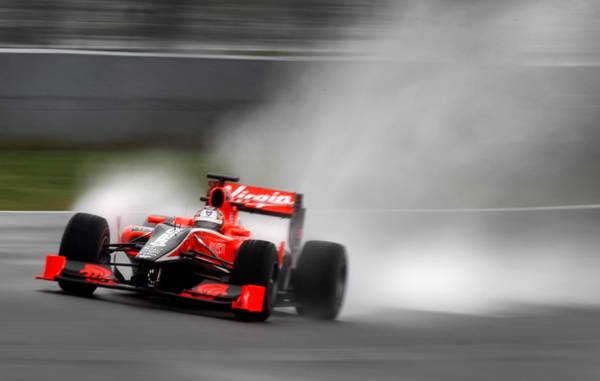
Virgin is already running, but when will we see US F1, Campos - or Stefan?

Today is Thursday February 11, and the significance is that in exactly four weeks the cars will be undergoing scrutineering checks in Bahrain.

It’s a scary statistic, and not just because I haven’t booked my flight yet. More importantly we still really don’t know how many teams we will see there. The saga over whether Campos Meta and US F1 will make it, or whether one of them will somehow be usurped by Stefan GP, continues to rumble on.

It took another curious twist yesterday afternoon when the FIA put out a statement reminding us that teams are obliged to take part in all events. Well, that’s what we’ve always thought, but in recent days both Bernie Ecclestone and Jean Todt have been quoted as saying that teams could miss three races. That gave Campos and US F1 some extra breathing space, even if physically getting to cars to China for the fourth race in April was going to be an expensive exercise in itself.

But then all of a sudden the FIA came up with this: “Following recent reports on the interpretation of clauses in the Concorde Agreement concerning the concept of a Team’s ‘participation’ in the FIA Formula One World Championship, the FIA wishes to make the following clarification: From a sporting and regulatory point of view, each Team that has registered for the Championship is obliged to take part in every event of the season. Any failure to take part, even for just one Championship event, would constitute an infringement both of the Concorde Agreement and the FIA Regulations.”

Well that’s pretty clear, and it’s how we’ve always understood things to be. But why did Bernie and Todt, the guys who should know, say something different? And where does it leave the two struggling teams, who one assumes, have (for who knows how long) been under the impression that they would be able to skip those races? Has there been a change of tactics to put pressure on those teams, and perhaps force an opening for Stefan GP?

Attempt to rescue Campos are ongoing – more on that in a later story – but the problem is that as I understand it, work on the car has pretty much been on hold in recent weeks, so Bahrain remains a distant target. Interesting times…

1 Comment

Filed under Uncategorized

The Red Bull RB6: Will it be the car to beat?

Gamesmanship or brilliant tactics? The RB6 was revealed at the last possible moment


Adrian Newey’s decision to wait until the second 2010 test in Jerez may prove to be a wise if those extra nine days of wind tunnel and development work on the RB6 prove to have made the difference, but if nothing else, he kept everybody guessing. And by not showing the car until just before it first ventured into the pit lane, he has given everyone else even less time to analyse and copy it! 

The car certainly looks the part, full of the little details and nuances you expect from Newey. Crucially of course this year he has been able to design it around the double diffuser concept from the start, and given how close the team came to taking last year’s title without that advantage, the opposition must be worried.

Newey isn’t giving much away for the moment, and he insists that it’s evolution, and not the revolution that some might have expected. But that is probably the best way to go about winning the 2010 title, given that there are some pretty major rules changes to deal with.

“The RB6 is very much an evolution of the 2009 car,” he says. “We tried to refine and evolve it rather than go to new concepts. As a result, the car looks similar with elements such as the chassis and pull-rod rear suspension retained. 

 “The two main challenges were the larger fuel tank and the smaller front tyre. With the fuel tank, there was more to it than simply putting a bigger tank in the car – it puts more load on the brakes, so the brake cooling has to cope with that and you also have to consider what effect that extra fuel will have on the tyre degradation early in the race and if there’s anything we should change mechanically to cope with that. The narrower front tyre changes weight distribution and the balance of the car. I think it’s a sensible evolution of the 2009 car. 

 “One obvious difference is that the 2009 car was not designed to suit a double diffuser and we had to try to put one on as best we could around the existing rear suspension and gearbox. With this car we’ve been able to design that part of the car from scratch.” 

The key thing now is that Webber and Vettel get in as many dry miles as possible during a test that has already been compromised by rain. Only 11 days of testing left… 

The top of the chassis is even more dramatically sculpted than before

2 Comments

Filed under Uncategorized

Senna and Grosjean join the queue at Stefan GP?

For a team that doesn’t quite exist yet, Stefan GP has attracted a lot of comment in recent weeks. It’s also been attracting a lot of drivers, as people wake up to the fact that the 2010 Toyota – even run by someone else – might not be such a bad car.

Kazuki Nakajima is already set for a race drive, and has been busy on the simulator in Cologne. There are obviously commercial considerations in taking him, and it wins Toyota some much needed positive PR in Japan.

Others in the mix include Romain Grosjean, Christian Klien and most interestingly, Bruno Senna. Grosjean apparently has some money, while the last named has a contract with Campos. However sources suggest that he has already been in touch, and if he has, it’s because he knows better than most which way the wind is blowing in Spain.

In fact the Brazilian would be an ideal choice, because he would create a certain amount of goodwill around the team. Any move to replace Campos with Stefan on the entry list, whatever form it takes, is bound to be complicated, and there may be objections from some quarters. But everyone, not least Bernie Ecclestone, can appreciate the boost to the sport that Senna’s name will provide if he jumps ship. If Stefan ends up buying Campos out, then keeping Bruno would be a no brainer anyway.

Ralf Schumacher has talked to the Stefan guys – it’s said he’s even been to Belgrade to meet them – but inevitably he told them he has no intention of bringing any money. It’s hard to see that his name on its own will attract any, or even why he’d want to come back in a team that, even with a decent base car and a few familiar faces around him, is not going to be challenging for podiums.

There have been questions about where the money is coming from, and Ecclestone raised a few eyebrows when he mentioned in the Sunday Express last weekend that there was government backing, and that he’d ‘met the prime minister.’

Since the former Mrs E is from neighbouring Croatia, and Bernie has strong links in the region, we have no reason to doubt him. In fact the funding is from an agency called SIEPA, or the Serbia Investment and Export Promotion Agency, whose role is to promote business in the country. It describes itself as “a government organisation dedicated to effectively helping foreign investors and buyers, while raising Serbia’s profile in the minds of international business decision-makers. Created in 2001 by the Government of the Republic of Serbia, SIEPA’s mission is to support foreign companies seeking to set up or expand in Serbia and Serbian companies when doing business worldwide.”

So that sounds pretty solid, but it seems unlikely that SIEPA is underwriting the whole thing, which is why Nakajima is on board and drivers with funding are of interest.

 Zoran Stefanovich is clearly a very clever and well-connected guy, and Bernie would not be backing him if he hadn’t been convinced. But from the outside, it all looks a bit messy, not least the stories about Stefan buying Dallara’s IP from under the nose of Campos. If true, it’s an amusing bit of gamesmanship – worthy of instant membership of the Piranha Club for Mr Stefanovich – but probably not very funny for Adrian Campos.

Whether Stefan finally gets in by formally taking over the Campos entry, or just by barging it out of the way, remains to be seen. Certainly Stefan’s attempt to show it means business by sending its sea freight to the opening races is a little presumptuous.

Matters have been further complicated by the ‘amnesty’ that will allow the new teams to miss the first three races. Not that it helps much, other than in terms of time, because the cost of just getting to race four in China on its own will not be insignificant. But when does a struggling team finally have to admit defeat – Thursday scrutineering in Shanghai?

Even with Ecclestone’s support you can’t talk you way onto the grid just because you have a car, and the FIA will have to make sure that everything is done by the book. I’d still love to see Jean Todt’s face if and when he signs off on a team whose technical director is Mike Coughlan…

There is a bigger picture, however. F1 would be silly to let the former Toyota team slip away, because in a year or two we might be desperate to find some serious candidates for the grid. The frustrating thing is that the Toyota board’s handling of its withdrawal was as heavy handed as BMW’s. Having saved its decision until after the last race, making a rescue almost impossible,Tokyo then refused to sanction a management buyout or allow a third party to buy its entry. 

That in effect would have meant selling a Toyota subsidiary, but clearly the paperwork could have been juggled to allow it to happen, and the team’s future would have been secured in November/December. Although that in turn would have made life complicated for Peter Sauber, who at that time was on the outside, looking in, as the ‘14th’ entry. Sorting that conundrum out would have been a big headache for his old pal Jean…

1 Comment

Filed under Uncategorized