
The latest technical directive from the FIA has given the teams food for thought
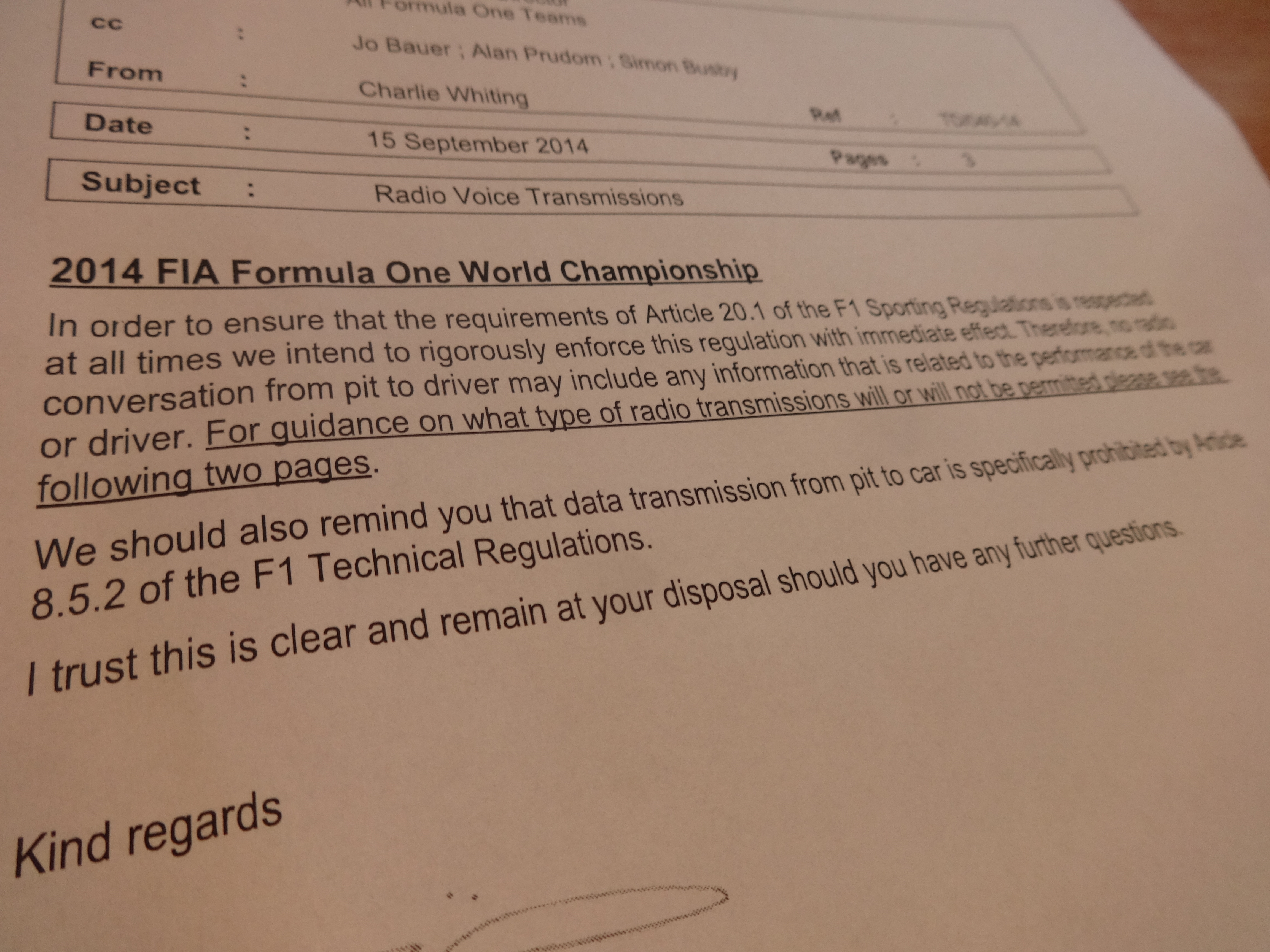
The FIA’s Charlie Whiting has sent the teams a further technical directive clarifying what can and cannot feature in pit to car radio conversations from the Singapore GP onwards.
Seen by this writer, the document confirms that a lot of technical information will also be banned from appearing on pit boards.
In some instances, regarding tyre and brakes, the ban has been postponed until the Japanese GP.
In addition the FIA has specifically targeted “any message that appears to be coded.”
The FIA has confirmed that the restrictions “apply at all times the car is out of its garage during the Event,” which means all practice and qualifying sessions are included.
Messages not permitted (either by radio or pit board)
Sector time detail of a competitor and where a competitor is faster or slower.
Adjustment of power unit settings.
Adjustment of power unit setting to de-rate the systems.
Adjustment of gearbox settings.
Learning of gears of the gearbox (will only be enforced from the Japanese GP onwards).
Balancing the SOC [‘State of charge’, ie ERS battery charge level – AC] or adjusting for performance.
Information on fuel flow settings (except if requested to do so by race control).
Information on level of fuel saving needed.
Information on tyre pressures or temperatures (will only be enforced from the Japanese GP onwards).
Information on differential settings.
Start maps related to clutch position, for race start and pit stops.
Information on clutch maps or settings, eg bite point.
Burn-outs prior to race starts.
Information on brake balance or BBW settings.
Warning on brake wear or temperatures (will only be enforced from the Japanese GP onwards).
Selection of driver default settings (other than in the case of a clearly identified problem with the
car).
Answering a direct question from a driver, eg “Am I using the right torque map?”
Any message that appears to be coded.
Messages permitted (for the avoidance of doubt)
Acknowledgement that a driver message has been heard.
Lap or sector time detail.
Lap time detail of a competitor.
Gaps to a competitor during a practice session or race.
“Push hard,” “push now,” “you will be racing xx,” or similar.
Helping with warning of traffic during a practice session or race.
Giving the gaps between cars in qualifying so as to better position the car for a clear lap.
Puncture warning.
Tyre choice at the next pit stop.
Number of laps a competitor has done on a set of tyres during a race.
Tyre specification of a competitor.
Indication of a potential problem with a competitor’s car during a race.
Information concerning a competitors likely race strategy.
Yellow flags, blue flags, Safety Car deployment or other cautions.
Safety Car window.
Driving breaches by team driver or competitor, eg missing chicanes, running off track, time penalty will be applied etc.
Notification that DRS is enabled or disabled.
Dealing with a DRS system failure.
Change of front wing position at the next pit stop.
Oil transfer.
Wet track, oil or debris in certain corners.
When to enter the pits.
Reminders to check for white lines, bollards, weighbridge lights when entering or leaving the pits.
Reminders about track limits.
Passing on messages from race control.
Information concerning damage to the car.
Number of laps remaining.
Driver instructions from the team to swap position with other drivers.
Test sequence information during practice sessions, eg aero-mapping.
Weather information.
Pit to retire the car.
(Note: Punctuation has been adjusted from original)



 Adam Cooper F1